Avoid the Red Zone of Death: Essential Marketing Strategy for Freelancers
Most founders bleed money building products nobody wants. A simple positioning matrix reveals why—and how to test demand for under $500 before you waste six months.

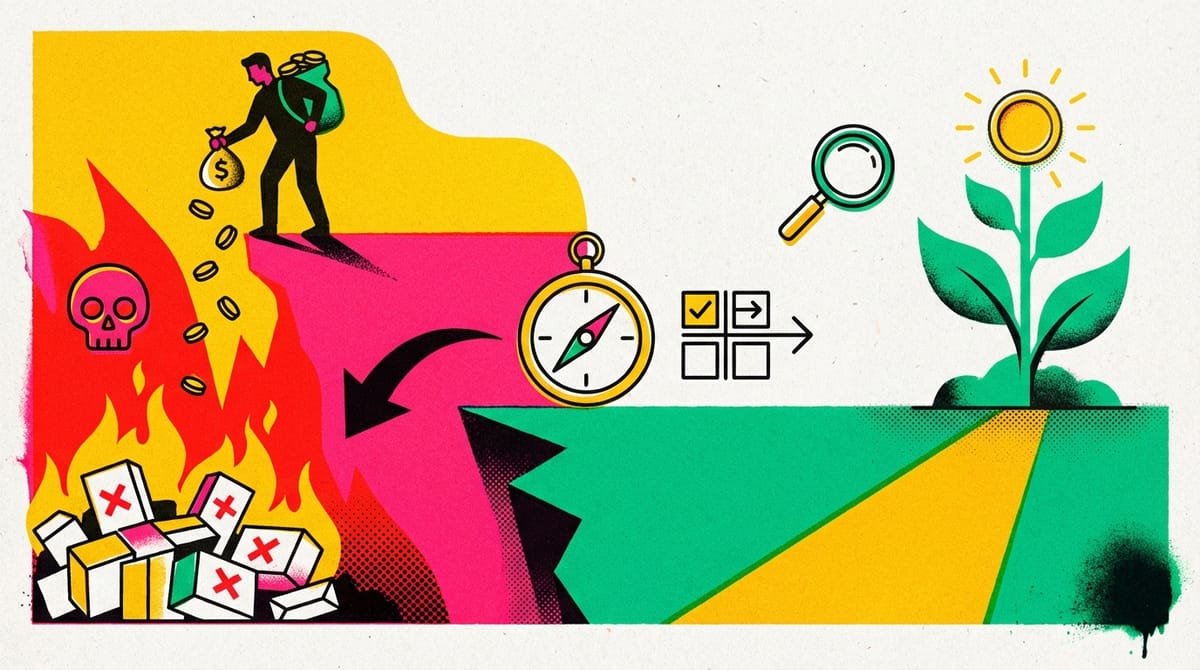
You spent months building it. Burned through your savings on ads. Sales? Zero. Sound familiar? The product isn't the problem. The problem is you never checked if anyone actually wanted it.
Two ways to launch
There's the painful path:
- Dream up a product
- Pour money into development
- Launch ads
- Crickets
- Slow financial bleeding
Then there's the other way:
- Have an idea
- Test the hypothesis
- Market doesn't care — pivot or kill it
- Market responds — double down
The difference? Path one costs you six months and $40K. Path two costs you two weeks and a few hundred bucks in test ads. Same information. Very different price tag.
The positioning matrix: where does your product sit?
Picture a simple 2x2. Horizontal axis: how many people want what you're selling. Vertical axis: how much they'll pay. Four zones emerge.
The red zone of death. Few buyers, low prices. This is where startups go to die. Founders build for themselves: "I need this, so others must too." They don't.
Real example. A startup built standalone mobile apps for individual podcasts. Sounds reasonable — podcasters get their own branded app, listeners get direct access. But nobody asked the listeners. People want everything in one place: Spotify, Apple Podcasts, YouTube. Nobody's keeping 20 apps for 20 shows. Company folded within a year.
Premium segment: few buyers, high prices
Different rules here. Small audience, but they'll pay serious money for specific problems solved.
Take triathlon gear. A $7,000 bike? Sure. $3,000 carbon wheels? Done. Why? Every gram matters. Every second counts. The market is tiny but obsessive.
Luxury fashion works the same way. A Birkin bag costs more than a used Honda. Manufacturing cost? Maybe $800. The rest? Story, status, membership in an invisible club.
Banks figured this out. The metal card with concierge service costs almost nothing extra to issue. But clients pay for exclusivity — for how the airport lounge staff looks at them when they flash it.
Mass market: fighting for pennies
Bottom of the matrix. Millions of buyers, but every one of them is price-sensitive. How do you survive?
Optimization. Relentless, boring optimization. Cut production costs by 3%? Good. Negotiate better shelf placement at Walmart? Better. Save twelve cents per unit on packaging? At a million units, that's $120,000 in profit.
But here's the trap. Store brands sit next to you — cheaper. Household names sit on the other side — more trusted. You're squeezed from both directions.
The only way out? Invest in brand, not just product. Without recognition and trust, you lose. Even with better quality.
The green zone: business holy grail
Upper right corner. Many buyers, high prices. Every founder's dream. Almost nobody gets there.
Smartphones are the rare exception. An iPhone costs what 50 flip phones used to. Yet billions of people save up and buy one. Why? Because it's not a phone. It's a camera, GPS, bank, entertainment system, and mobile office in your pocket.
Building a green-zone product means creating a new category. Not improving what exists — inventing something people won't live without.
Marketing starts before the product
Remember the SaaS boom and the rise of AI solopreneurs? Thousands of founders launched products, built impressive technology, and... shut down. Why?
They started with technology, not customer problems. The survivors found their market first, then built for it. Whether by luck or intention doesn't matter. What matters is they thought about the market from day one.
Marketing isn't the ads you run at the end. It's understanding who needs your product, what problem it solves, and what they'll pay — before you write a single line of code.
What to do right now
Take your product. Or your idea. Answer honestly:
- Which zone are you in?
- If red — can you move? Or is it time to shut it down?
- If premium — do you actually understand your buyer? Their specific pain?
- If mass market — where can you cut costs? How do you build brand recognition?
And the real question: have you verified that the market wants this? Or did you just assume that because you want it, everyone does?
Start with the market. The product can wait.