Freelancers: Prevent Sales Chaos with These Critical Materials
Marketing affects sales directly through ads—and indirectly through the people who close deals. Without the right materials, chaos is guaranteed.

Why Marketers Can't Manifest Sales
The CEO asks: "Where are the sales?" The marketer shrugs.
Sound familiar?
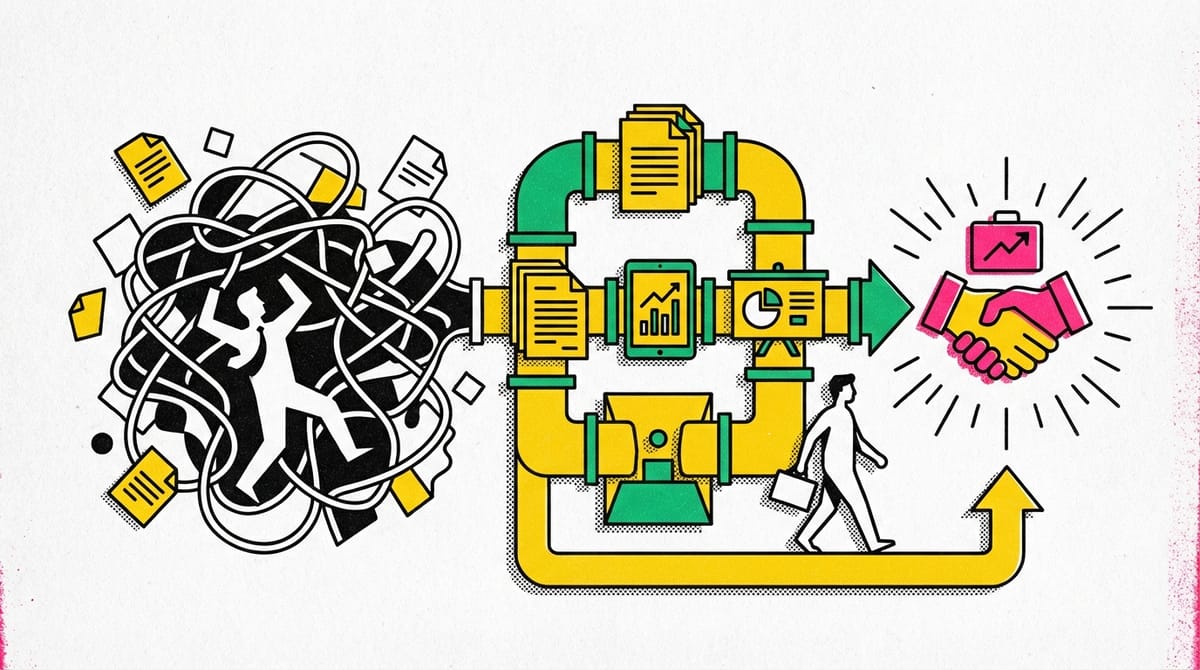
Marketing affects sales two ways. First—direct: performance ads, leads, conversions. Pour in budget, get results.
Second—indirect: supporting the people who actually close deals. Partners, referrals, salespeople.
This is where chaos begins.
What to do: Find out who's bringing clients to payment. They need materials.
Salespeople Are Closers, Not Copywriters
Salespeople close deals. Creating content? Not their job.
What they need from marketing:
- Proposal templates—ready-to-use docs with customizable sections
- Case study library—5-7 success stories for different client types
- Objection FAQ—answers to "too expensive," "let me think about it," "prove it"
- Battlecards—competitor comparisons they can pull up on calls
- Referral kit—what to give someone who recommends you
No materials—the salesperson improvises.
Problems guaranteed.
What to do: Start with an objection FAQ. 10 common questions, ready answers. Saves hours every week.
When Salespeople Overpromise
Consultant Mike takes on a strategy project. Client asks: "Is implementation included?" Mike wants to close. "Sure, of course."
A month later—conflict.
Implementation isn't in the contract. Client's unhappy. Mike either works for free or loses the client and his reputation.
Since January 2025, California's Freelance Worker Protection Act requires written contracts. Other states are following. "Verbal promise" = legal risk.
Ready-made materials with clear scope—insurance against stupid situations.
What to do: Create a proposal template with a "What's NOT included" section. Prevents 90% of conflicts.
Case Study: Creator Sells Course Through Affiliates
Sarah launches a $500 copywriting course. 10 partners promote it for commission.
Each partner needs:
- Sarah's photo and bio (with usage rights)
- Course description—who it's for, what they'll get
- Social proof—testimonials, student results
Creator media kit in 2026: name, photo, 2-3 sentence bio, followers by platform, engagement rate, audience demographics, top content, contact info, pricing.
No kit—partner grabs a photo without rights. Writes their own description. Promises extras—"personal review for everyone" with 200 buyers.
Result: copyright issues, unhappy customers, damaged reputation.
The best affiliate programs make it impossible to screw up. Step-by-step tutorials, ready-made posts. The principle: the easier it is for partners to sell correctly—the less overpromising.
What to do: Work with referrals? Give them a media kit. Don't count on them figuring it out.
How This Scales
Consultant Alex works solo. 5 regular referrers recommend him to their network.
A referrer tells a client: "Alex does strategy in a week." Alex delivers in three. Expectations don't match.
Client's disappointed before the project even starts.
Without a referral kit, everyone passes along their own understanding. Multiply by referrers—chaos.
What to do: One-pager for people who recommend you. What you do, who it's for, price, timeline. One page saves dozens of awkward conversations.
What Marketers Should Do
Preparing templates and FAQs isn't the most exciting work.
But who else is going to do it?
Big companies have entire teams for this. It's called sales enablement—supporting sales with materials to close deals.
Solo consultant? You're the sales enablement team. Create a document once—use it for months.
You can dump money into ads. But if support materials don't exist—leads will slip away at closing.
No budget will fix that.
What to do: 2 hours a week creating sales materials. In a month—basic kit done.
For Freelancers and Consultants
Sales enablement for a team of one looks different. Not 50 documents.
5 right ones.
Proposal template with modular structure. Don't rewrite from scratch every time. Sections: problem, solution, timeline, price, what's not included. Change only the problem for each client.
Case study library of 5-7 stories. Different niches, different problems. New lead comes in—send a relevant case in 30 seconds.
Objection FAQ. "Too expensive"—answer ready. "Guarantees?"—answer ready. "Why not an agency?"—answer ready. 2 pages to review before every sales call.
Referral one-pager. What you do, who it's for, price, contact info. Send to every happy client after the project.
Onboarding checklist. What the client prepares before kickoff. Cuts ramp-up time, shows professionalism.
What to do: Start with the proposal template. One template saves 2-3 hours per client.
What Doesn't Work
Three approaches that kill sales.
Rigid scripts for calls. Read word-for-word—you sound like a telemarketer. Clients hear it instantly.
Trust = zero.
✅ Instead: Know the structure, use your own words. Personalize for each conversation.
Over-polished proposals for creative work. 20-page proposal for a $3,000 project—red flag. Either you're spending way too much time, or you're copy-pasting a template without adapting.
✅ Instead: 2-3 pages max. Problem, solution, price, next step.
Jumping to the pitch in LinkedIn DMs. "Hey! I do X. Want to hop on a call?" 95% ignored. No context—no trust—no response.
✅ Instead: Engage first. Comments, reactions, mutual connections. Then a personalized message with a specific reason.
Tools
Gamma—AI-powered proposal creation. Prompt to presentation in 3 minutes. Free tier available, Pro from $20/month.
✅ gamma.app
Notion—home base for case studies, FAQs, templates. Free for personal use. Single workspace, keyword search.
✅ notion.so
What to do: Pick one tool. Move your first document. You don't need a perfect system—you need to start.
Bottom Line
Leads without sales materials = wasted leads.
Performance budget won't help if clients get improvisation instead of a clear proposal.
Create 5 core documents. Use them for months. Update quarterly.
This isn't bureaucracy. It's making sure every lead gets to payment.