Freelancers: Stop Guessing, Start Proving Your Brand's Value
Your brand positioning is probably based on assumptions. Three simple research methods—from gut instinct to actual client feedback—reveal what people really think.

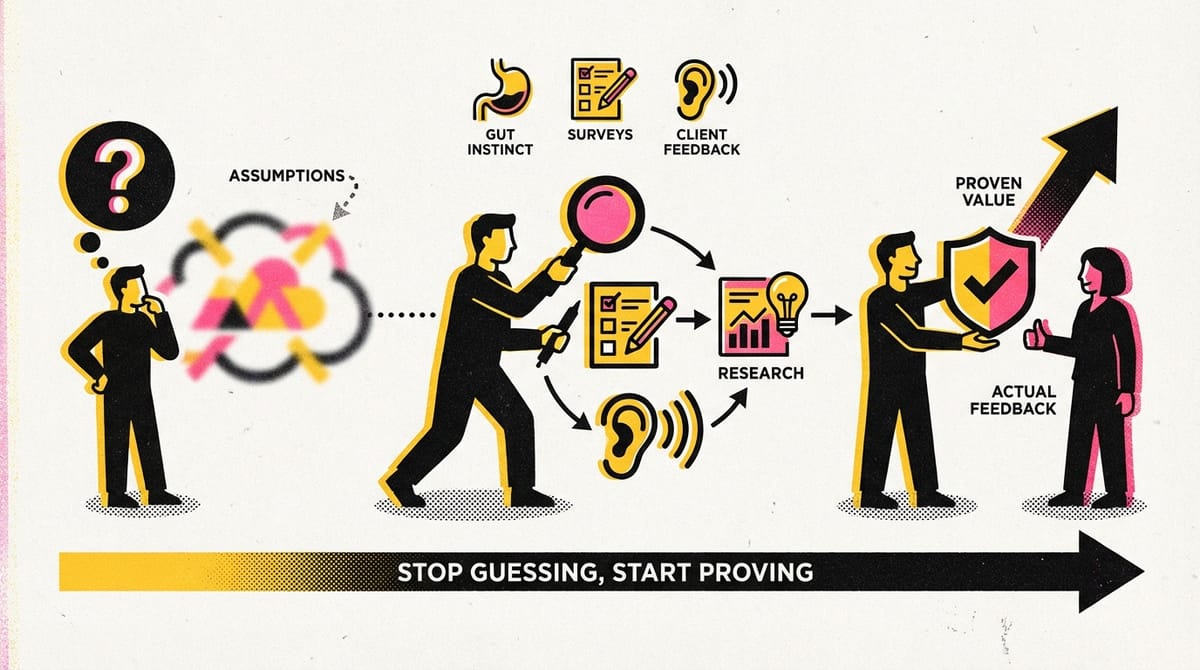
Three Ways to Research Your Brand: From Gut Feelings to Actual Evidence
Performance marketing is straightforward. Spend money, run ads, get leads, close sales. Boring, but predictable.
"Creative" stuff like brand perception? That's where things get messy.
Here are three paths marketers take.
Path One: "I Just Feel It"
Describe your opinion about your brand, sprinkle in "people think." Could be true. Could be fantasy. No way to verify.
A freelance copywriter writes on their site: "Clients value my personalized approach." How do they know? They don't. They assume.
Maybe clients value their speed. Or their rates. Or the fact that they don't ask too many questions.
Without data, you're just guessing.
Takeaway: No data? Don't assert. Write "I believe" instead of "people think."
Path Two: "It's in the Manifesto"
Restate your brand manifesto, again using "people think." Example: "People think we deliver high quality."
Whether they actually believe that? Mystery.
A marketing consultant pulls the client's positioning from an investor deck and drops it into the strategy. "We're innovative market leaders." Sounds impressive.
But on Clutch, clients write: "Solid team, delivers on time."
No innovation. No leadership. A manifesto is what a brand wants to be. Not what people actually see.
Takeaway: The manifesto is your starting point. Not your final answer. Check whether the internal picture matches the external one.
Path Three: Talk to People
Collect data. Find patterns and outliers. Draw conclusions.
State your limitations.
A freelance designer wants to understand why some clients come back and others don't. She doesn't "think about it" or reread her LinkedIn profile.
She emails 5 past clients: "What mattered most about working with me?"
Three respond: "You didn't disappear between calls." One says: "Fast." One doesn't reply.
Now she has data: 3 out of 4 respondents value communication over speed.
Small sample—but it's no longer fantasy.
A Practical Process
- Collect data. Start free: Google Forms for surveys, reviews on Clutch/Upwork, LinkedIn comments, reasons prospects gave for passing after discovery calls.
- Find patterns. What repeats? What surprises you? Three people said the same thing—that's a signal.
- Draw conclusions. Not "clients value quality" (meaningless), but "4 out of 5 clients mentioned response time as the reason they hired me again."
- State limitations. "Surveyed 5 clients from the past year. All B2B, all US-based. Not representative of European clients."
Combine quantitative and qualitative data. Surveys show WHAT's happening. Interviews explain WHY.
Numbers give scale. Conversations give depth.
Action: Block 2 hours. Email 5 past clients. Ask one question: "What was the deciding factor in working with me?" Takes 20 minutes to send. The answers will reshape your positioning.
Rule: A Claim Without Proof Is Just an Opinion
Writing "most people think"? Link to a study. Talking about pricing frustrations? Quote a review.
Making claims about competitors? Link to a comparison table.
A marketer's job is to think. But not "I was thinking the other day" thinking. It's "I think this because here's the document I analyzed" thinking.
| Claim | Required Evidence |
|---|---|
| "Most clients..." | Link to survey or research |
| "Clients are unhappy with X" | Quote from a review + 2-3 similar ones |
| "Competitors do Y" | Link to comparison table |
Test: Before every claim, ask yourself: "How do I know this?" If your answer is "it feels right"—rephrase or find proof.
For Independent Professionals
Brand research isn't just for corporations with budgets. For independents, it matters more: you don't have a marketing department to compensate for positioning mistakes with ad spend.
Your Data Sources (Free)
Discovery calls. Track why prospects reached out and why they didn't buy. Patterns in rejections are gold for positioning.
Platform reviews. Clutch, Upwork, LinkedIn recommendations. Don't just read yours—read your competitors'. What do clients praise? What do they criticize?
Social media comments. When you post content—what resonates? Which posts get saved? Which ones spark replies?
Reasons for repeat business. Ask directly: "Why did you come back to me specifically?" The answer often doesn't match what you assumed.
Minimum Viable Research: 2 Hours
- Email your last 5 clients: "One thing that was decisive about working with me?"
- Scan 10 competitor reviews on Clutch—note what gets praised and criticized.
- Review your last 10 discovery calls—why did 3 of them not buy?
Result: you have data. Not a lot, but enough to stop guessing.
Start here: Pick one source. Today, email 3 clients. Tomorrow, check competitor reviews. Small steps beat "someday I'll do a big research project."
What Doesn't Work
Even the "right" approach can fail. Here are the traps that kill research value.
Looking only for confirmation of your hypothesis
You're convinced clients value your expertise. So you ask: "How important is my expertise to you?"
Of course they'll say "important"—you asked a leading question.
Instead: "What was the deciding factor?" Open question, no hints.
Leading questions
"You liked how fast I worked, right?" That's not research. That's fishing for compliments.
"What worked well? What could be better?" That's research.
Small sample without disclaimers
3 responses doesn't equal "most clients think." It equals "3 clients said."
Write your limitations explicitly: "Surveyed 3 people from 2 segments."
Honesty about sample size isn't weakness. It's professionalism.
Ignoring negative feedback
One client said communication was poor. You wrote them off as "difficult." A second said the same thing. Then a third.
Those aren't difficult clients. That's a pattern.
Negative feedback is your most valuable data.
Action: Before your next client survey, reread your questions. Any leading ones? Any open-ended ones? Did you note your sample limitations?
Tools
Brand perception research doesn't need a budget. Start with free tools:
| Tool | Purpose | Cost |
|---|---|---|
| Google Forms | Collect client responses—NPS, feedback, reasons they chose you | $0 |
| Google Trends + Reddit | Understand what people search and discuss in your niche | $0 |
Principle: validate free first. Paid tools come when free ones can't keep up.
Experienced marketers pick the third path—talk to people and gather data.
Lazy ones pick the first or second.
The difference between "I think" and "the data shows" is the difference between guessing and working. You don't need a lot of data. You need some.
3 client responses beat 0. 5 competitor reviews beat your fantasies about their positioning.
Start small. One question. 5 clients.
Today.