How to Survive Crunch Time Without Burning Out Your Project—or Yourself
Crunch mode isn't a badge of honor—it's what happens when your plan dies and you're too busy scrambling to build a new one.

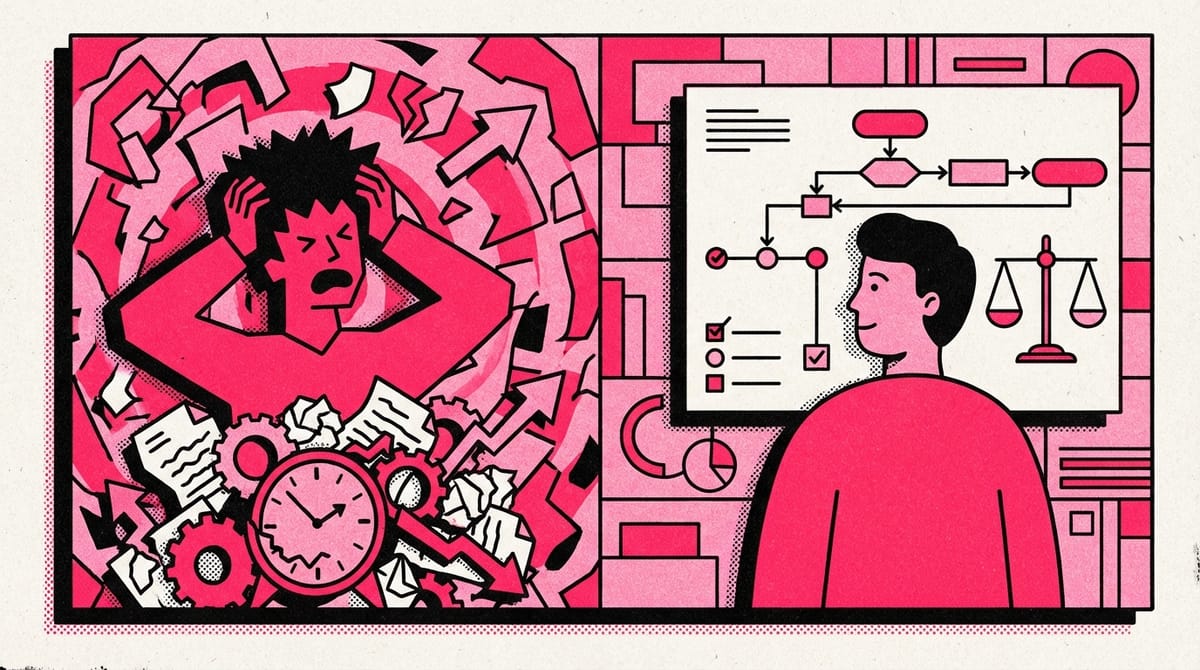
Crunch mode isn't just "a lot of work." It's when your old plan is already dead, but a new one hasn't emerged yet. The team scrambles, people stay until midnight, frantically finishing edits, renders, designs — while making more and more mistakes along the way.
Here's the key insight: crunch mode isn't about heroism — it's a symptom of broken project management. And you can't muscle your way out of it through sheer willpower alone.
What actually happens during crunch
When everything's on fire, most people react the same way:
- they abandon proper workflow;
- they start pulling all-nighters, working weekends, juggling everything at once;
- they make decisions on the fly, without documenting them or thinking through consequences.
In the moment, it feels like you're saving the deadline. In reality, the opposite happens:
- you're editing the final export instead of the source files — after a few rounds of revisions, you can't make one change without breaking three others;
- you're working exhausted: mistakes multiply, details slip through the cracks, tasks get forgotten;
- you're destroying your health and the client's trust, but you're not solving the root problem — the absence of a plan.
Crunch mode is not just "a lot of work."
Crunch mode is working without a plan and outside your proper workflow.
Why you can't break process and just "push harder"
Every profession relies on its own production workflow:
- an editor makes changes in the project file, not in an already-exported render;
- a designer edits the source file, not "touching up" a flattened JPG;
- a developer commits code to the repo, not randomly editing files in production.
The moment you abandon proper workflow during crunch, you:
- accumulate technical debt in the most literal sense — bugs, band-aids, hacky workarounds;
- make every subsequent revision harder;
- make the project increasingly fragile: any small thing could bring it all crashing down.
Doubling your effort in this situation doesn't help.
If the system is built wrong, pressing the gas harder just means you'll hit the wall faster.
What to do instead of chaotic heroism
The only mature way out of crunch mode is to stop and rethink the game.
Steps:
- Pull the emergency brake.
- Take inventory of the project.
- Assess your resources.
- Create a new realistic plan.
- Have the conversation with the client.
From this point on, crunch mode stops being crunch mode.
You're working from a plan again — a new one, yes, but agreed upon and process-driven.