Stay Legal, Stay Safe: The Essential POS Strategy for Small Businesses

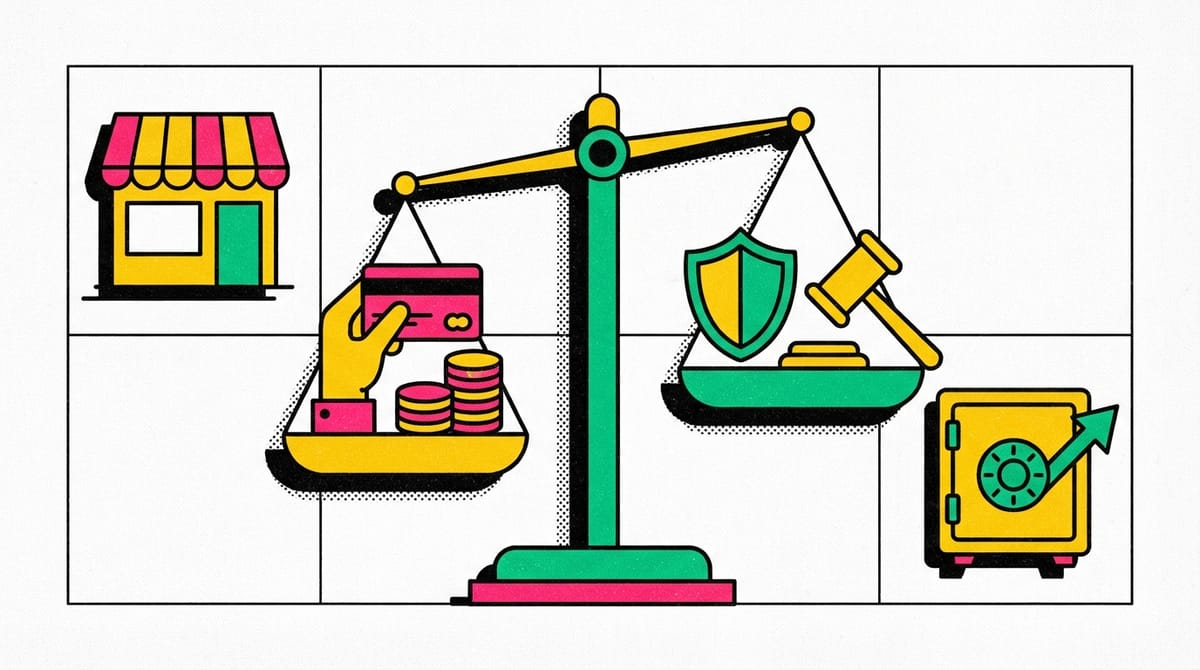
In 2017, new regulations hit small businesses: every retailer needed a point-of-sale system that transmitted receipts directly to tax authorities. No compliance, no business license. Suddenly, millions of shop owners went from "I just want to sell stuff" to "I just want to sell stuff without getting fined".
Context
I was the marketer for a company that made these POS systems. Every strategic question we've been discussing? I had to answer them for real.
Where product teams go wrong
Here's where most product teams go wrong. They start researching and suddenly they're designing elaborate dashboards — sales analytics, price trends, employee performance metrics. Features multiply. The roadmap bloats.
But the core problem never changed: people don't want to get fined.
That's it. Everything else is decoration.
Product requirements
Once you accept that, the product requirements become obvious. Business owners needed to know when the law applied to them. They needed software that didn't crash. They needed reliable internet connectivity — which meant both a SIM card slot for cellular backup AND an ethernet port for hardwired connection. They needed compatibility with their existing card readers and inventory systems.
The ideal product? Pay and forget.
- Simple setup.
- Rock-solid uptime.
- Multiple connectivity options.
- Works with whatever software they already use.
That's the dream.
Maybe you can't ship all of that in version one. But you know where you're headed. And notice what's not on that list: a fancy analytics dashboard. Could be useful eventually. But not first. Not even fifth.
Marketing message
This reframes your entire marketing message.
First priority: Help people understand when they need to comply. What's the deadline? Does this apply to them?
Second priority: Explain why your solution fits. Simple integration. Universal compatibility. Reliable transmission. Multiple backup options.
The anchor message: You pay, you forget, you stay legal.
Two conversations in parallel
Now, here's a wrinkle. We didn't sell directly to shop owners. We sold through service centers — essentially distributors who handled installation and support. B2B2C.
This means two completely different conversations running in parallel.
To distributors, you talk specs. Margins. Volume discounts. How much they'll earn per unit.
To end customers, you talk peace of mind. Deadlines. Compliance. Where to buy.
Same product. Completely different language.
Channel strategy
The channel strategy follows from the messaging. First, you need reach — special projects, partnerships, educational content explaining what these regulations mean and when they kick in. You're creating awareness of a problem, not pushing your solution yet.
Then you layer in performance marketing. Search ads on Google catch people actively looking. Retargeting follows visitors who checked your site but didn't buy. Social ads hit the right demographics.
What would be a mistake? Celebrity endorsements. Influencer integrations with general-audience creators.
This is a niche product for a specific audience. A lifestyle YouTuber with two million subscribers reaches everyone — which means reaching almost nobody who matters. You're paying for eyeballs you can't convert.
Compare that to selling, say, consumer snacks. Mass-market TV with a sports star? Perfect. The product is for everyone. The channel matches.
Timing and content
Content marketing is trickier. Timing matters enormously.
Starting a content strategy in 2020 for a compliance deadline that's already mostly passed? Probably worthless. Content doesn't work instantly. You publish, you wait, you build authority over months or years.
But rewind to 2017, when the regulations first dropped? Four years of content building toward a 2021 final deadline? That's plenty of runway. The investment compounds.
Pricing and segment
Pricing was straightforward: we went low. Micro and small businesses were our segment. These owners saw zero added value beyond "not getting fined." They weren't paying premium prices for compliance they resented.
Remember the positioning spectrum — lots of customers paying little, or few customers paying more? We chose volume.
Retention and ecosystem
Retention looks different when you're selling hardware.
Nobody replaces a working POS terminal because a newer model came out. It's not a phone. It works, they keep it.
But you can build a product ecosystem. Personal dashboards as a paid upgrade. Integrations with inventory systems. Supplies they'll need to reorder. Software for tracking regulated products — alcohol, pharmaceuticals, whatever requires special handling.
Cross-selling works. But only if you've actually researched what they need — not just because someone in a meeting said "we should build analytics."
Lesson
The lesson: you don't need every tool in the marketing handbook. Most situations need three or four approaches, done well. The rest is expensive noise.
Pick what solves your problem. Skip what's merely fashionable.