Task trackers aren't for everyone
Tasks pile up, go stale, and haunt your to-do list forever. What if they just… disappeared on their own?

More precisely, they're for everyone — but context is everything: how, where, and what you're using them in
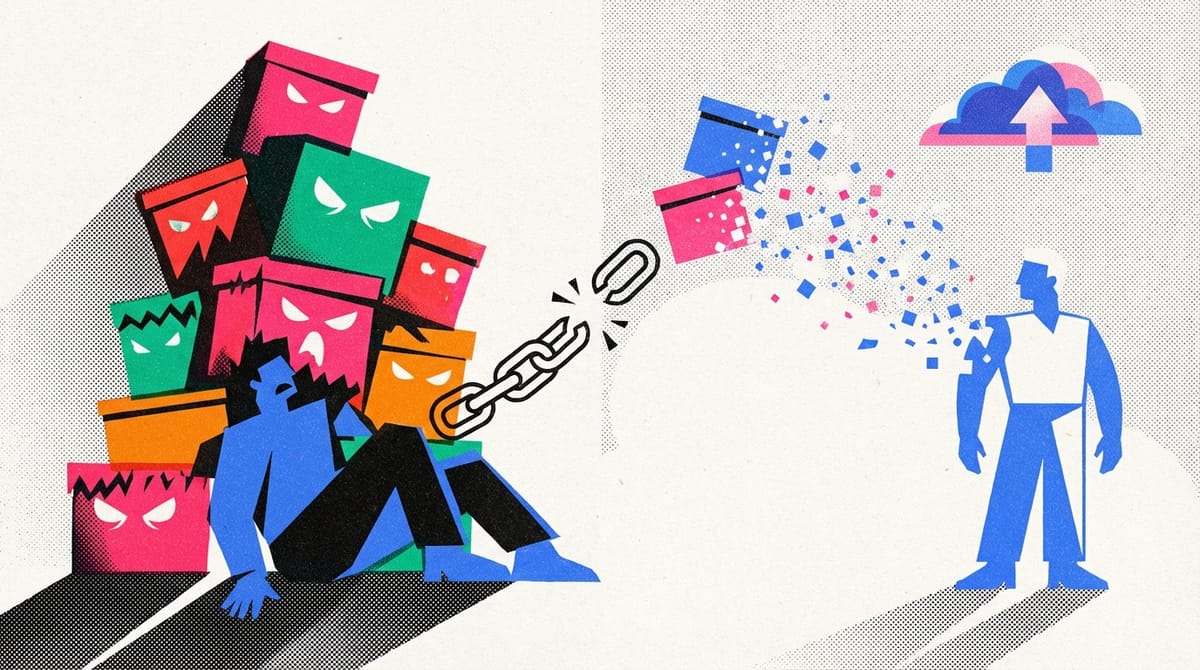
My main problem with task trackers — tasks in them go stale and disappear into the void.
This is the root of all evil, everything else is just a symptom. If tasks in a tracker self-destructed on time, there'd barely be a problem.
Why tasks go stale in the first place
Let's say you're keeping a task list.
You're a disciplined, responsible person who dutifully writes everything down.
You picked a convenient tracker that makes it easy to dump things in.
This means:
- tasks get into the tracker easily
- tasks pile up fast
- over time, it turns into a junk drawer
In real life, tasks go stale on their own:
- some were never important to begin with, but you didn't realize it when you wrote them down
- some lose relevance over time
- sometimes people just stop bugging you about stuff
- sometimes a task drags on so long that the world has changed, and it's no longer needed
In real life, this sorts itself out naturally:
- you conveniently forget about something
- or the people who assigned you tasks conveniently forget about you
Memory quietly takes out the trash. You don't need to consciously blow something off — it just fades away on its own.
But in a task tracker, it's the opposite
For a task to disappear from a tracker, you have to actively cross it out.
And that's where it gets ugly:
- crossing out a task is a decision
- decisions require resources
- sometimes it hurts, because it feels like you're not crossing out a task — you're crossing out possibilities
This is hard to do. Ideally, your subconscious would handle it — like it does with regular thoughts. But your subconscious doesn't have API access to your task tracker.
The result:
- any tracker pretty quickly turns into a garbage heap of old useless crap
- this garbage heap needs cleaning
- to keep a tracker relevant, you need to manage it as a system, not just "write stuff in there"
That's what managers are for. But even they need to be competent and not afraid to throw out the excess.
What my ideal tracker looks like
In practice, right now it's my paper notebook:
- I write ideas and tasks in it
- cross them out
- write again on a new page
- sometimes rewrite with a different angle
- I use different colored pens — so navigating this chaos is easy for me
- I love paper and writing by hand — my brain thinks better that way
At the same time, I have:
- Notion set up
- projects with tasks linked to them
- everything neat and proper
But this only actually becomes essential when working with a team.
I also like Apple's Tasks and Notes — that's more of a "personal" thing.
But for personal stuff, I have my notebook.
How a dream tracker should work
- Every task has a default lifespan, say, 1 week.
- After a week, the task becomes semi-transparent, and 5 days later it completely disappears from your inbox, without any action from you.
- If you do anything with the task — add to it, edit it, move it — its lifespan resets, and it lives another week.
- If you really need to find an old task, you go to that hidden section and:
A little military philosophy
It's like in the army:
- if someone brings you an order — don't execute it right away
- put it in a pile
- if it's important — they'll remind you, then pin it to the board
- if you get chewed out — then do it, but it rarely gets to that point
Provocative, sure, but that's roughly how it works in your head. It'd be cool if task trackers were closer to this reality.