The Brutal Truth About Using Performance Marketing for Freelancers
Most freelancers burn cash on ads that'll never pay off. The math is brutal—and there's a smarter way to fill your calendar.

Performance Marketing: What It Is and How It Drives Sales
Why does a business need marketing? To make sales. Everything else is a side effect.
Here's an example: you're a marketing consultant. You have two ways to get clients—online (LinkedIn, Upwork, cold emails) and offline (conferences, networking, referrals). It's a regular workday. You're staring at an empty calendar. Where are the clients?
Why Marketing Doesn't Affect Everything
Marketing drives sales. But it doesn't drive all channels equally.
Fast vs. Slow Channels
Online channels respond fast. Run LinkedIn ads, send a batch of cold emails, publish a post. You see results within a week.
Offline channels are harder. Referrals depend on reputation you've built over years. Networking takes months of showing up at events. No quick levers here—only accumulated trust.
What to do: Split your channels into "fast" (paid ads, outreach, content) and "slow" (referrals, networking, SEO). Fast channels deliver now. Slow channels build a foundation for years.
When You Need Clients Right Now
The classic advice: run ads.
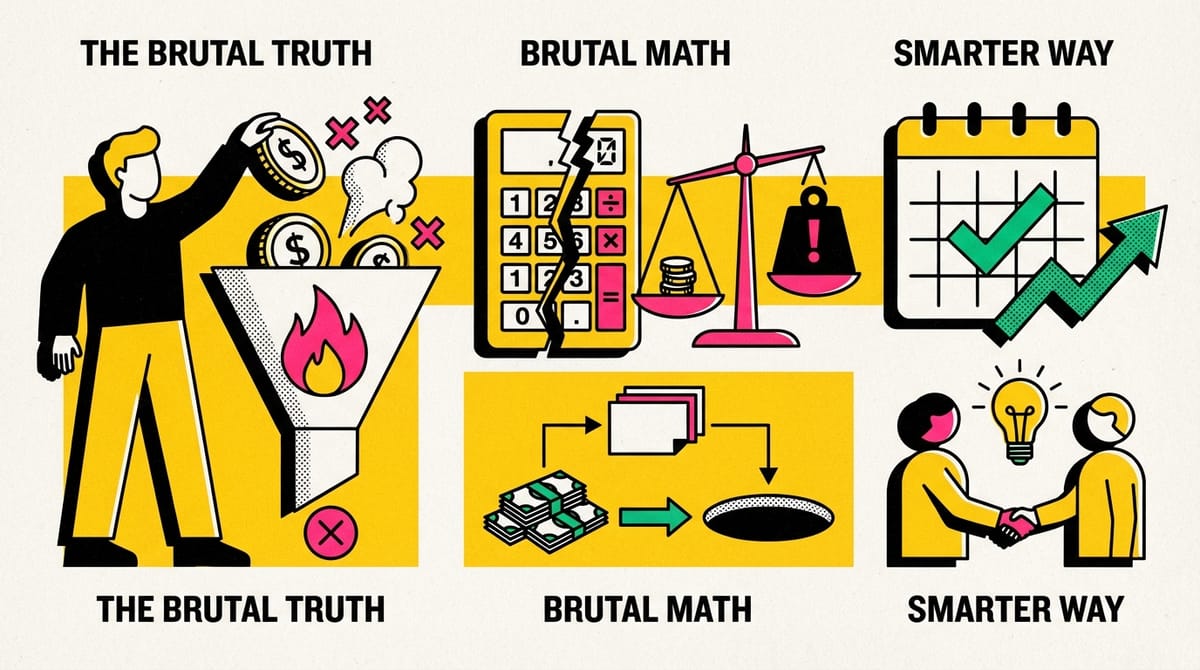
But for freelancers and consultants, paid advertising rarely works. Customer acquisition cost (CAC) is too high. If your average project is $3,000 and you're spending $500-800 on Google Ads to land one client—the math doesn't work.
Alternatives That Work on a Tight Budget
LinkedIn content. A consultant posts 3 times a week—case breakdowns and common client mistakes. Zero ad spend. Gets 3-5 discovery calls per month from target clients.
Cold email. A 3-person agency sends 50 personalized emails a week. 8% convert to calls, 2% to clients. That's 4 new clients a month with zero ad budget.
What to do: If your budget is under $1,000/month—don't spend it on paid ads. Invest your time in content and outreach instead.
The Relationship Between Budget and Results
If a channel works, the relationship is direct: more money means more sales. Pour in a lot, get a lot. Pour in a little, get a little.
But only up to a ceiling.
Understanding Diminishing Returns
An app founder hit $90K MRR entirely through organic content—a network of 50 creators posting videos on TikTok, Instagram, and YouTube. Best month brought in $200K revenue. Then growth flatlined. To go from $90K to $400K MRR, organic stopped working. They had to add paid ads.
This is called diminishing returns. Every channel has a ceiling. Past that point, more investment doesn't produce proportional growth.
What to do: Track CAC for each channel. When client acquisition cost starts climbing faster than revenue—the channel has hit its ceiling. Time to add a new one.
Marketing Without Budget Is a Myth
Even "free" tools cost something. LinkedIn posts take 5-10 hours a week. Cold email requires research and personalization. Content means shooting, editing, promoting.
But some industries make paid ads a losing game—one sale costs too much. Others spend $100 to acquire a client who brings in $5,000.
Unit Economics Determines Channel Choice
Calculate: how much does it cost to acquire one client (CAC) and how much will that client bring over your working relationship (LTV). If LTV/CAC is below 3—the channel is unprofitable long-term.
What to do: Before launching any channel, run the unit economics. CAC × 3 should be less than LTV.
Retargeting and Email: Tools for Bringing People Back
Someone visited your site but didn't fill out a form. Retargeting reminds them about you on social media. It brings back potential clients.
But in 2026, retargeting works differently. After iOS 14.5+ and the shift to cookieless tracking, pixel-based retargeting lost its edge. For independent consultants and creators, email sequences work better.
Email Marketing Is Alive and Kicking
Email marketing has been called dead for years—but it's alive and kicking. More than that, email is the backbone of the creator economy. Owned audience matters more than ever.
Leila Hormozi repositioned her newsletter: instead of generic advice, she started publishing internal memos she sends to her team. The result—emails felt 10x more unique because readers got backstage access to a real business.
What to do: Build your email list from day one. It's the only channel you fully control.
Collaborations with Other Creators
Traditional influencer marketing—paying a blogger for a sponsored post—rarely works for freelancers. Too expensive, too unpredictable.
But creator-to-creator collaborations are different.
Long-Term Partnerships Over One-Off Sponsorships
Baby product brand Moonboon shifted from one-off sponsorships to a long-term ambassador program. Result: over $1M in partner sales, 10% of monthly revenue from the creator program, 6.5x average ROI. 90% of new creators now come organically.
For freelancers this means: don't pay for influencer ads. Build partnerships—mutual referrals, joint projects, cross-promotion.
Collaborations have their own timelines. Agree today, see results in a month. Want clients by end of quarter? Start building partnerships now.
What to do: Find 3-5 peers in adjacent niches. Propose a mutual exchange: you recommend them to your clients, they recommend you.
Where to Send Traffic
All these tools only work if there's somewhere to send people. No conversion point—nowhere to direct traffic from ads, content, referrals.
Minimum Viable Conversion Point
In 2026, this doesn't have to be a "website" in the traditional sense. For creators, these work:
- A landing page on Carrd or Landy AI ($9-27/year)
- A services page on Gumroad or Whop
- Even a well-designed Linktree
The point is one place where someone takes action: submits an inquiry, books a call, buys.
What to do: Minimum setup—a one-page landing with a contact form. Without this, any marketing loses half its effectiveness.
What Performance Marketing Includes
Search ads. Retargeting. Email. Collaborations. Content. SEO. All of it is performance marketing. The kind that drives measurable sales.
Channels for 2026
For freelancers and creators in 2026, add:
- Social selling—direct sales through LinkedIn and Twitter DMs
- Community-led growth—participating in professional communities
- Affiliate/referral programs—a systematic approach to recommendations
- AI-driven discovery—optimizing for ChatGPT and Perplexity (15% of ChatGPT users ask for product recommendations)
For Freelancers and Consultants
Performance marketing for services works differently than for products.
Key Differences for Service Businesses
Long sales cycle. Clients don't buy consulting on impulse. From first touch to contract—weeks or months. This means nurturing matters more than immediate conversion. Email sequences, regular content, staying top of mind.
Trust-based purchase. Clients don't buy a service—they buy confidence that you'll solve their problem. Case studies, testimonials, and demonstrated expertise work better than discounts and promotions.
High ticket = fewer clients. With average projects at $5,000+, you need 2-4 new clients a month, not 200. This changes strategy: better to have 10 deep conversations than 1,000 cold touches.
Action Steps
What to do:
- Build an email funnel: lead magnet → welcome sequence → regular content → offer
- Publish case studies in "problem → solution → result" format
- After every project, ask for 2-3 referrals
What Doesn't Work
These approaches sound logical. But they kill results.
Relying Only on Referrals
❌ The mistake: Referrals matter—most freelancers built their business on them. But it's not the only strategy anymore. Markets shift, seasons pass, the flow of recommendations slows down without warning.
✅ Instead: Combine your referral pipeline with active marketing. Test new approaches, stay visible.
Social Media Without a Funnel
❌ The mistake: Posting for the sake of posting is noise. Without a clear path from awareness to conversion, followers don't become clients.
✅ Instead: Build a 4-stage funnel: awareness → engagement → lead acquisition → conversion. Each post moves someone along the funnel.
Traditional Influencer Marketing with Flat Fees
❌ The mistake: Consumers spot paid ads instantly. Trust drops. One-off sponsorships for a fixed fee are losing effectiveness.
✅ Instead: Outcome-based models (CPA, revenue share), long-term partnerships, micro-influencers with high engagement.
A Static Website You Never Test
❌ The mistake: A brochure site that hasn't changed in a year is a dead asset. User behavior matters more than aesthetics.
✅ Instead: Regular A/B testing of headlines, CTAs, page structure.
Ignoring AI-Driven Discovery
❌ The mistake: 15% of ChatGPT users ask for product and service recommendations. That's a growing channel you're missing.
✅ Instead: Structured content with clear answers to common questions. FAQs, specific value propositions.
Tools
| Tool | What it's for | Price |
|---|---|---|
| Carrd | Simple one-page website | $9/year |
| Landy AI | AI landing page builder with A/B testing | $27/month |
| Whop | Sell services, courses, and subscriptions in one place | Commission on sales |
| Sequenzy | Email marketing + transactional emails | Freemium |
The Bottom Line
Performance marketing isn't "dump budget into ads." It's a system of channels, each driving sales in a measurable way.
The Formula for Freelancers and Consultants
- A conversion point (landing page)
- An email list (owned audience)
- One fast channel (content, outreach)
- One slow channel (referrals, SEO)
Track CAC and LTV for each channel. Double down on what works. Cut what doesn't pay off.
Marketing exists to drive sales. Everything else is a side effect.