The Critical Sales Framework Freelancers Need to Master

Two skills you need to sell through your blog
Here's what I wish someone told me when I started selling through my blog: you need two separate skill sets. Writing content and making sales are different muscles. Most people get decent at one and wonder why the other isn't working. Today I'm focusing on the sales side.
What selling really is
Let me clear something up first. Selling isn't manipulation. It's not convincing people to buy things they don't need. Selling is an exchange. You have something valuable. Someone else has money and a problem they want solved. When those match up, everyone wins. That's it. No sleaze required.
The three elements of every sale
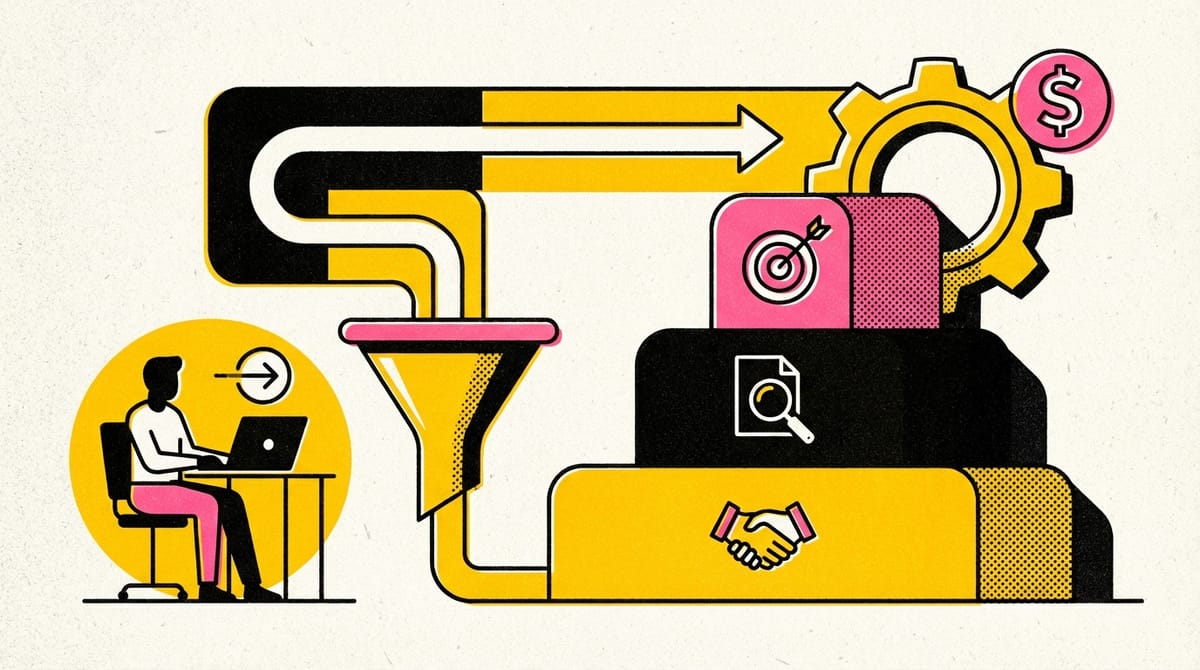
Every sale breaks down into three elements: what you're selling, who you're selling to, and how they find you. Simple framework, but most failed launches can be traced to screwing up one of these three. Here's how I think about it. Say you need to get across town for a meeting. You could take an Uber — comfortable, expensive. The subway — fast, cheap, crowded. Walk — free, but you'll arrive sweaty and late. Same destination. Three different products at three different price points serving three different needs.
How different options win for different people
Each option wins for someone. Uber's pitch is comfort and saved time. The subway sells speed and value. Walking? That's for people who have margin in their schedule and want the exercise. This is what product positioning looks like. You're not just selling a thing — you're selling why your thing is the right choice for a specific person in a specific situation.
Audience and buying context
Now, audience. I personally bounce between Uber and the subway depending on the day. I'm not in the market for a car. Zero interest. But my parents? They need a vehicle — different life, different priorities. Car ads targeting me are wasted spend. But here's the twist: I might still influence my parents' purchase decision. I'm not the buyer, but I'm in the conversation.
Your ideal customer is situational
Your audience shifts based on what you're selling and when. Someone browsing condos downtown has different criteria than someone looking for suburban homes. Same person might be in both audiences at different life stages. The point: your ideal customer isn't a fixed profile. It's a person in a specific moment with a specific problem they're ready to solve.
Markets and new options
Markets evolve constantly. A few years ago, e-scooter rentals didn't exist. Now they're everywhere — Lime, Bird, Spin. Another option for getting across town. Another company competing for the same customer need. This happens in every market. New solutions appear. Customer awareness shifts. The products that win are the ones that actually reach the people who need them.
Channels: how customers discover you
That's the third element: channels. How do potential customers discover you exist? Could be paid ads. Could be partnerships with complementary brands. Could be content — articles, newsletters, podcasts. For me, it's my blog and newsletter. That's my primary sales channel. Your personal platform is a channel you control. No algorithm changes, no platform risk. That's the whole point of building an audience you own.
Applying the framework to different offers
I run every offer through this same framework: what am I selling, who needs it, and how will they find it? My consulting: I sell strategy sessions to solo professionals building content businesses, and they find me through this newsletter and referrals. A coffee cart in an office building: they sell caffeine and pastries to building employees, and foot traffic plus a few well-placed flyers are the channel. Same framework scales from a $6 latte to a $6,000 engagement.
Diagnosing broken sales
When sales aren't happening, one of these three elements is broken. Either the product doesn't solve a real problem, you're talking to the wrong people, or nobody can find you. I've made all three mistakes. I've built products nobody wanted. I've marketed to audiences who couldn't afford what I was selling. I've had great offers that nobody saw because my distribution was weak. The fix is always the same: identify which element is failing and run experiments.
Your job as a seller
Your job is to learn the toolkit, test hypotheses, and keep putting valuable work into the world. Every sale you'll ever make fits this framework: what you sell, who you sell to, and how they find you. Get clear on all three and the rest is iteration. Start by auditing what you have now. Which of the three elements is your weakest? That's where you focus next.