Uncover Your Offline Marketing ROI with Unique Codes and Links
Track every offline channel with unique codes, links, and QR analytics—finally know which conferences, podcasts, and networking events actually bring clients.

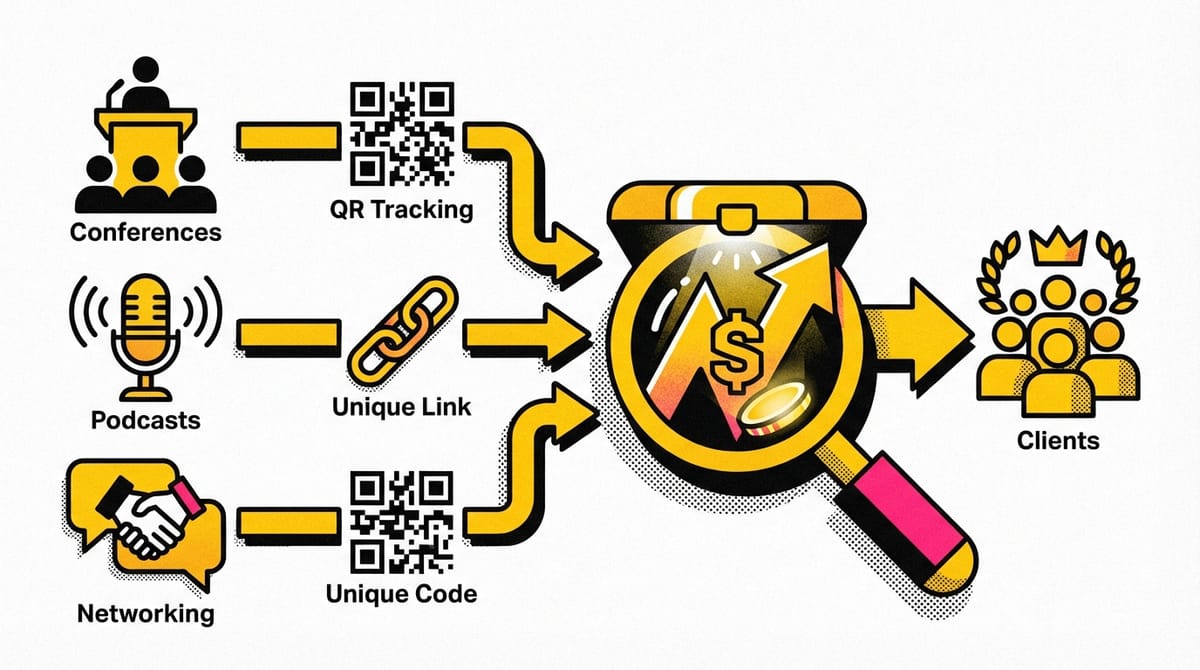
How to Measure Offline Marketing When You Can't Track Clicks
There's no magic analytics for brand awareness campaigns. Forget "brand lift studies"—that's marketing theater.
But three methods actually work. They give you real numbers.
Promo Codes
One unique code per channel. Speaking at a conference? Give attendees CONF2026. Sponsoring a podcast? Create PODCASTVIP. Handing out business cards at a meetup? Print MEETUP23.
What Most People Do
One promo code—ALEX2026—everywhere. The code gets used. You have no idea which channel triggered it.
What Works
When you sponsor a podcast, create a unique code AND a dedicated landing page:
- Code:
PODCASTVIP - Page:
yoursite.com/podcast
Listener enters the code—you see the source. One show's audience responds better than another? You'll see it in redemptions. Now you know where to double down.
Action step: Create a separate code for every offline channel. Keep a spreadsheet with:
- Code ✅
- Channel ✅
- Date ✅
- Redemptions ✅
Unique Booking Links
For freelancers and consultants, conversion isn't a sale. It's a booked call.
How It Works
- Spoke at a conference? Share
calendly.com/yourname/conf-april - Published a guest post? Use
calendly.com/yourname/guest-blog - Every booking in your calendar is tagged by source. Automatically.
Real Example
Freelance content writer Rosanna Campbell uses separate Calendly links: one for client calls, another for coaching sessions. Different client types come from different channels. Her stats show exactly which.
Action step: Create 3-5 Calendly links for your main channels. Name them clearly: /linkedin, /podcast, /referral.
QR Codes With Analytics
Business card, presentation slide, conference handout—QR code on everything.
Static vs Dynamic QR Codes
| Static QR | Points to a fixed URL. Zero analytics. |
|---|---|
| Dynamic QR | Lets you change the destination and collect data: scans, devices, cities. |
What to Track
- Business card? QR to your Linktree with a UTM tag
- Slide deck? QR to a free resource
- Conference handout? QR to your booking page
- Every scan gets logged
Action step: Use dynamic QR codes (ShortPen, Flowcode). Static ones are a blind spot.
A/B Testing Offline
If you have volume, test.
What to Test
- Two versions of your business card with different CTAs. Different QR codes.
- Two pitch variations: one emphasizes speed, the other quality. Different promo codes for different podcasts.
A month later, check the numbers:
- Which CTA got more scans?
- Which pitch led to more follow-up conversations?
- Which podcast brought paying clients?
Action step: Run one A/B test this month. Two versions of one asset. Two different identifiers. Measure.
Читайте также
- The Critical Shift to Mobile-First Design You Can't Ignore
- The Essential Guide to Aligning Marketing Channels with Business Goals
- The Brutal Truth About Using Performance Marketing for Freelancers
The Golden Rule
One channel, one identifier.
For Freelancers and Consultants
Offline channels for independents aren't billboards. They're networking and expertise.
Speaking and Podcasts
Every appearance gets its own promo code. "Listeners of this show get 15% off with code SHOWNAME."
A month later: Podcast A brought 3 clients, Conference B got zero responses.
Business Cards and Networking
Your QR code points to a page with a UTM tag. Not your homepage—a specific landing page.
Result: meetup cards got 12 scans, conference cards got 47.
Referrals
A separate link for each referring client: yoursite.com/from-clientname. You see who actually sends business.
Action step: Pick one offline channel. Set up a unique identifier. Track it for a month.
What Doesn't Work
Relying on "How Did You Hear About Us?"
People forget. They mix things up. A client says "Google" when they actually saw your LinkedIn post, forgot about it, then searched your name later.
Surveys supplement tracking—they don't replace it.
One Promo Code Everywhere
ALEX2026 on your business card, in a podcast, and at a conference. The code works—but you have no clue where it came from. Data's polluted.
Launching Without Tracking Set Up
Platforms optimize based on signals. No conversion signals? Your money goes to clicks, not results.
Click-Based Attribution
The client journey is fragmented: Instagram ✅ Google ✅ review ✅ direct visit. A single click won't show you the full picture.
Combine methods: tracking + surveys + common sense.
Remember:
- Every channel needs its own identifier
- Surveys are a supplement
- Set up tracking before you spend money on ads
Tools
| Tool | Purpose | Price |
|---|---|---|
| ShortPen | Dynamic QR with analytics: device, country, post-scan actions | Free plan |
| Cal.com | Scheduling with Routing Forms—client questions + different meeting types | Free + paid plans |
| Blinq | Digital business cards with QR and scan analytics | Basic free |
| Switchy | UTM tracking and short link analytics | $47/month |
| Parsley | Link-in-bio with professional sales analytics | Free plan |
Start With One Channel
Measuring offline marketing isn't rocket science. Three methods. One principle. Keep it simple.
Don't buy expensive attribution platforms. Set up the basics:
- One channel
- One identifier
- One month of data
A month from now, you'll have an answer: the channel works or it doesn't. That's more than 90% of freelancers know about their marketing.