Value Proposition: A Key Element of Your Business Model
Your value proposition isn't just what you do—it's the unique combination of novelty, performance, and ownership that makes clients choose you over everyone else.

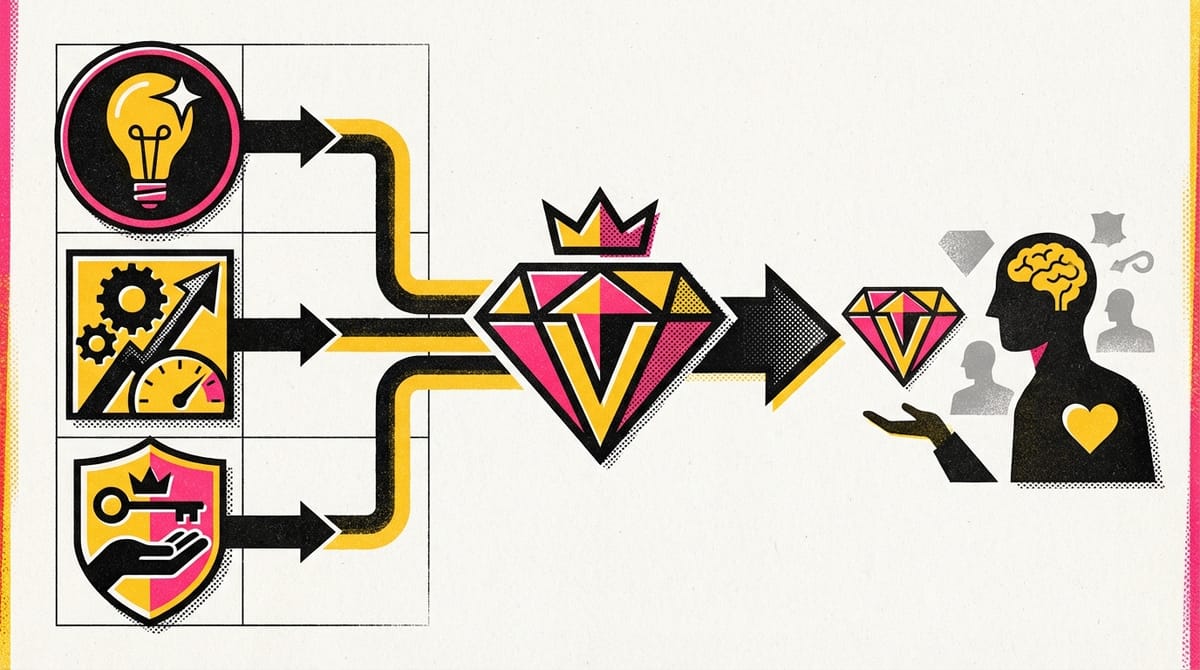
What makes up your value proposition
Novelty
You solve problems no one has tackled before — or solve them in a fundamentally new way.
Examples:
- A developer specializing in LLM integration into existing products — this specialty didn't exist a year ago
- A product manager with expertise in AI-first products
- A consultant helping traditional businesses transition to Web3
- A UX researcher working with neural interfaces
Novelty creates a temporary monopoly: until the market gets saturated with specialists, you can command premium rates.
Performance
You do the same thing as others, but faster, better, or at greater scale.
Examples:
- A senior developer who ships in a week what a junior would take a month to build
- A copywriter who delivers text that needs zero edits
- A designer whose mockups don't need rework after testing
- A project manager who delivers on time 90% of the time (versus the industry average of 60%)
But performance has a ceiling: there's always someone who works even faster. That's why it's rarely the only element of a value proposition.
Customization
You tailor solutions to each specific client rather than selling a template.
Examples:
- A business consultant who builds strategy around your specific situation instead of regurgitating textbooks
- A developer who architects systems for your actual load requirements, not "the way it's usually done"
- A career coach who works with your unique story instead of following a script
- A marketer who studies your unit economics before recommending channels
Customization takes more time and deeper engagement — and that's exactly why it commands higher fees.
"Doing the client's job"
You take ownership of an entire area of responsibility so the client can focus on their business.
Examples:
- Fractional CTO: a startup gets a technical director without a full-time hire — you own the entire technical strategy
- Online course producer: the expert just records content, everything else (platform, funnel, launch) is your domain
- DevOps engineer on retainer: the company doesn't think about infrastructure, you just "make everything work"
- Outsourced CFO for small businesses
The Rolls-Royce model — selling "flight hours" instead of engines — works for individual specialists too: you're not selling hours of work, you're selling outcomes and peace of mind.
Brand and status
Working with you sends a signal to the market.
Examples:
- A designer whose name in a portfolio adds credibility to the product
- A consultant who's ex-McKinsey or ex-Google — your former employer's status transfers to the client
- An investor-advisor whose name on the cap table attracts other investors
- A well-known open-source project maintainer
Brand takes time to build, but it creates a durable advantage: clients come to you and willingly pay a premium for the association.
Price
You deliberately operate in the lower price segment but compensate through volume or automation.
Examples:
- Template solutions: pre-built Webflow sites, standard pitch decks, off-the-shelf integrations
- Courses instead of consulting: you teach hundreds of people instead of working with one client
- Productized services: "Landing page audit for $299" with a clear scope
This is a viable model, but it requires scale. One cheap project won't pay the bills — you need volume.
Reducing client costs
You help clients spend less — on infrastructure, people, tools.
Examples:
- Cloud cost optimization consultant: companies overpay AWS/GCP by 2–3x, and you find where
- HR consultant who designs processes so the company hires fewer people
- Business process automation specialist: implementing no-code solutions instead of custom development
- Financial analyst who uncovers hidden expenses
If you save a client $100,000 a year, your $20,000 fee looks like a great deal.
Risk reduction
You reduce the likelihood of failure, financial loss, or reputational damage.
Examples:
- Technical due diligence before acquiring a startup
- Security audit before product launch
- Legal review of contracts
- MVP testing before scaling
- "Second opinion" on architecture from an independent expert
Clients pay for risk reduction especially willingly when stakes are high: major investments, public launches, regulatory requirements.
Accessibility
You make available what only large players could previously afford.
Examples:
- Fractional model: small businesses get a CFO, CMO, or CTO for a few hours a week instead of a full-time hire
- Group consulting: instead of $500/hour one-on-one — $100/hour in a group of 10
- Async consulting: clients pay for written responses instead of calls
- Micro-services: not a full rebrand for $50,000, but a "logo audit" for $500
Democratizing expertise is a powerful trend, and you can build a sustainable business on it.
Convenience
You're simply easy to work with.
Examples:
- You're in the right time zone and available when it's convenient for the client
- You have a clear process: the client always knows what's happening and what's next
- You work in the client's tools instead of making them learn yours
- You handle communication with all stakeholders, not just the person who hired you
- You have fast onboarding: work can start tomorrow, not after a month of approvals
Convenience is underrated, but it's critical for busy people. If you're easy to work with — you get referrals.
How this connects to price
Each element of your value proposition adds to your price.
A specialist who:
- works in an emerging niche (novelty)
- takes ownership of project management (does the client's job)
- has reputation and referrals (brand)
- reduces the risk of failure (risk reduction)
- is easy to work with (convenience)
...can charge 10–30x more than a specialist with the same technical skills but without these elements.
Instead of a conclusion
Your price isn't "what an hour of work costs" or "what the market charges."
Your price is the sum of the value you create for the client: cost savings, risk reduction, speed, convenience, status, peace of mind.
The question isn't "what am I worth," but "what value do I create and how can I increase it."