Why Your Sales Funnel Isn't Working and How to Fix It
Most consultants overcomplicate their sales funnel. The fix starts with five lines on paper and knowing exactly where clients get stuck.

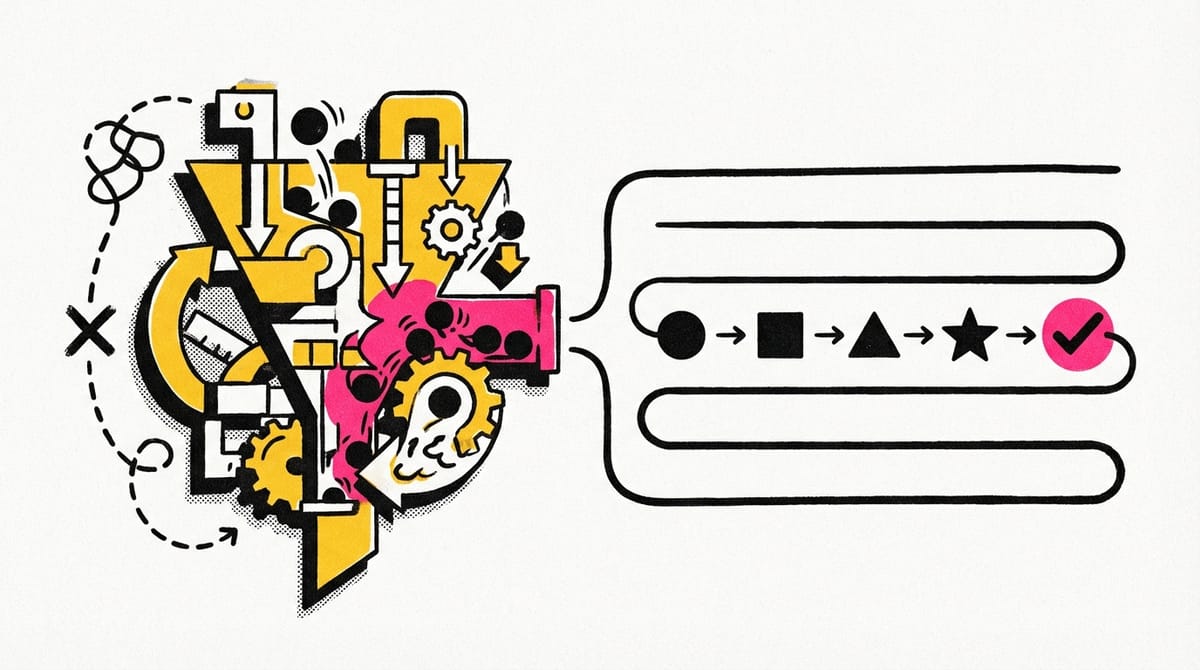
The Sales Funnel Isn't Magic—It's a Thinking Tool
The sales funnel is one of marketing's most overused metaphors. It sounds like alchemy. In reality, it's just a way to organize your thoughts about how clients find you.
If you're a consultant or freelancer, you won't be designing funnels in Figma. What matters is understanding how a client moves closer to hiring you.
Five Steps: A Consulting Example
Let's take a specific service: marketing strategy consulting for SaaS startups. The funnel for this service has five stages.
Step 1: They Don't Know You Exist
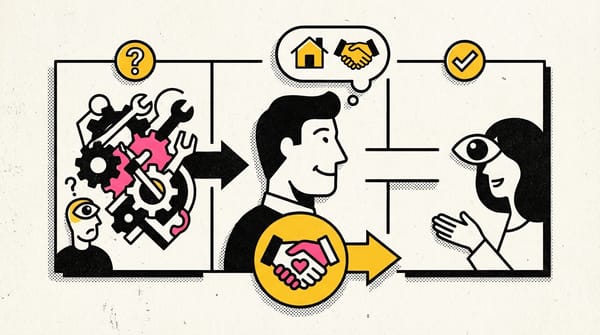
A startup founder has no idea who you are. They haven't even recognized the problem—that their marketing is chaotic and burning cash.
Then they read your LinkedIn post and realize: chaotic marketing isn't normal. There's a better way. Now they're aware.
Step 2: They Start Looking
They begin researching who can help. They check your profile, read your case studies, compare you to alternatives.
Step 3: They Compare Options
Once they've found 3-4 candidates, they start figuring out what makes you different. This is where proof matters: case studies, testimonials, specific results.
Step 4: They Buy
Discovery call done, contract signed. Now the real work begins: will you deliver on the promise?
Step 5: They Come Back
If you deliver results, they return for the next project. Or they become an advocate—recommending you to their network.
Action step: Draw your funnel on paper. Five lines. Label where your potential clients get stuck.
What Works at Each Stage
When Demand Doesn't Exist Yet
At the first step, targeted ads won't help—there's no demand to capture. Nobody's searching for "SaaS marketing consultant" because they don't know they need one.
Your job is to create demand. For a solopreneur, that means:
- Regular content on LinkedIn or Twitter—mistake breakdowns, case studies, insights
- Guest appearances on podcasts your target audience listens to
- Collaborations with people who already have access to your potential clients
| Claim | Evidence |
|---|---|
| Trust beats Distribution | Tobi Oluwole built creator-led businesses to $4M in revenue over 5 years on LinkedIn. Creators with 5,000 followers and high authority earn more than those with 100,000+ pushing generic content. |
This takes time. One post changes nothing. You need to consistently push the idea that your service solves a real problem.
Action step: Pick one platform where your target audience lives. Post 2-3 times per week for 3 months. Track where your discovery calls come from.
When They Know the Category Exists
Now your job is to prove you're better than the alternatives. What works:
- Case studies with specific metrics ("increased landing page conversion from 2% to 7%")
- Testimonials from recognizable clients
- Comparison content: "Why a retainer works better than project work for your type of business"
Action step: Write 3 case studies using the formula "Problem → What we did → Results in numbers." Post them on your site and LinkedIn Featured section.
When They're Ready to Buy
Your service needs to be easy to purchase. If a client is ready but doesn't understand the next step—you've wasted all that effort.
For freelancers and consultants, this means:
- A clear services page (not "contact us to discuss"—specific packages)
- A simple way to book a call (Calendly, SavvyCal)
- Fast response to inquiries (within 24 hours)
PPC and SEO help here—when the client is actively searching. But for most solopreneurs, paid ads aren't cost-effective. The person who responds fastest to a warm lead wins.
Action step: Review your website as if you were a client. In 30 seconds, they should understand: what you do, who it's for, how to get started.
When You Need Them to Come Back
The final stage is retention. For consultants and freelancers, this matters more than you think:
| Claim | Evidence |
|---|---|
| Retention is a top priority for sales leaders | 73% of sales leaders prioritize growth from existing clients. 57% rank retention in their top 3 priorities. |
What works:
- Repackaging one-off projects into ongoing retainers (instead of "I'll build your landing page" → "3-month conversion optimization support")
- Regular check-ins with past clients (quarterly)
- Asking for referrals after successful projects
Action step: After every completed project, send your client an email: "Thanks for working together. If you know someone who needs similar help, I'd appreciate the introduction." 80% of new freelance projects come this way.
Why Services Are Different
A services funnel isn't a product funnel. You're not selling a thing. You're selling trust in your expertise.
Awareness through expert content
You can't buy ads for "pricing consultant." But you can write a post called "Why Hourly Rates Kill Your Income"—and the people who see themselves in it will remember you.
| Claim | Evidence |
|---|---|
| LinkedIn content builds awareness for consultants without ad spend | Anna Lundberg, a consultant for solopreneurs, builds awareness entirely through LinkedIn content. Her approach: a platform full of decision-makers + organic reach + personal brand as trust signal. No ad budget—just content and consistency. |
Consideration through case studies and proof
The client is comparing you to others. Show them you've solved their problem before. Cobloom's approach: instead of hard selling, they offer a free strategy review. They convert these into long-term advisory contracts.
Conversion through clear offers
"Book a consultation" is weak. "30-minute pricing review—free if you meet these criteria" is specific.
Читайте также
- Why Your Funnel Lacks Momentum and How to Fix It
- The Brutal Truth About Social Media and Sales
- The Brutal Truth About Using Performance Marketing for Freelancers
Managing a funnel solo
| Claim | Evidence |
|---|---|
| Solopreneur funnels have 3 key stages | Anna Lundberg describes the solopreneur funnel as: Awareness (content attracts the right people) → Consideration (case studies, proof, clarity) → Conversion (clear offers and direct conversations). AI helps with content drafts and admin. But it doesn't replace thinking. |
What Doesn't Work
These approaches used to be standard. Now they kill conversions.
❌ Vague offers like "book a consultation" with no specifics
Why it fails: Busy professionals need clarity and a next step that feels tangible.
✅ Instead: Stage-appropriate offers. At Awareness—a checklist or guide. At Consideration—a demo case study. At Conversion—a specific next step with a clear outcome.
❌ Generic content aimed at everyone
Why it fails: People are more skeptical now. They do more research and expect more value before buying.
✅ Instead: A small audience of 5,000 with high authority earns more than 100,000+ with diluted content.
❌ Complex multi-step funnels with 10+ emails
Why it fails: Leaky funnels lose sales. Every extra step is another dropout point.
✅ Instead: Clean funnels with clear offers and minimal steps. Fast checkout.
❌ "I work with everyone"—no clear target audience
Why it fails: Leads to impersonal messaging that resonates with no one.
✅ Instead: Define 2-3 specific segments. Tailor your message to each.
Tools
| Tool | Purpose | Price |
|---|---|---|
| Calendly | Book discovery calls without back-and-forth | Free / from $10/mo |
| Notion | CRM for tracking leads and clients | Free / from $10/mo |
| ConvertKit | Email for creators with simple automation | Free up to 1000 / from $15/mo |
| Loom | Video replies instead of long emails (speeds up sales cycle) | Free / from $15/mo |
Why Measurement Is Hard
It's tough to calculate ROI from LinkedIn posts or podcast appearances. Their contribution to long-term sales matters—even if you can't trace it directly.
A practical approach for solopreneurs: ask every new client "How did you find me?" Log the answers in a spreadsheet. After 6 months, you'll have a clear picture of where clients actually come from.
In a big company, different specialists own each stage of the funnel. You don't have that luxury. But you have an advantage: you see the whole picture. You can quickly change what isn't working.
The funnel isn't magic. It's a framework for thinking. Draw yours, find the weak link, strengthen it.
Repeat.